

Table of Contents
- Understanding the Unique Challenges of Gifted Children with ADHD
- Recognising the Signs: Is It Giftedness, ADHD, or Both?
- Twice-Exceptional 2e Strategies for Home Learning
- Managing Executive Dysfunction in Gifted Children
- A Strengths-Based Approach to ADHD: Building on What Works
- Creating a Calm, Flexible Learning Environment at Home
- When to Seek Further Support and Resources
- Conclusion: Helping Your Gifted Child with ADHD Thrive
- Frequently Asked Questions
Last Updated: 14 October 2026
Understanding the Unique Challenges of Gifted Children with ADHD
Supporting gifted children with ADHD starts with recognising that you are parenting two distinct profiles at once. Giftedness and ADHD can mask each other, which means bright children often slip through the net for years.
A gifted child absorbs ideas fast, asks deep questions, and thinks in leaps. A child with ADHD struggles to start tasks, hold focus, and manage time. Put both together and you get a learner who can discuss philosophy for an hour but cannot find a pencil.
This combination has a name. Twice-exceptional, or 2e, describes a child who is both gifted and has a learning difference such as ADHD. These children are not rare, but they are frequently misunderstood.
Why Misdiagnosis and Missed Identification Are So Common
Misdiagnosis happens because each profile hides the other. A gifted child may coast through early years without effort, so nobody notices the attention difficulties underneath. Later, when work gets harder, the struggles look like laziness or behaviour problems.
The reverse also occurs. A child diagnosed with ADHD may have their giftedness overlooked because teachers focus on the challenging behaviour. Many parents describe years of being told their child is “not trying hard enough”.
Common reasons identification gets missed:
- Bright children compensate for attention problems with quick thinking
- Assessments often test one profile at a time, not both together
- Schools rarely screen for giftedness and ADHD in the same child
- Behaviour gets labelled before ability gets measured
If this sounds familiar, trust your instincts. You know your child better than any single report.
Recognising the Signs: Is It Giftedness, ADHD, or Both?
The clearest sign of both is uneven performance. A child who reads two years above their age but cannot finish a worksheet in forty minutes is showing you two profiles at once.
Look for these patterns:
Signs of giftedness:
- Learns quickly and remembers detail
- Asks unusual, complex questions
- Becomes intensely absorbed in topics of interest
- Thinks abstractly earlier than peers
Signs of ADHD:
- Loses track of time and tasks
- Interrupts or blurts out answers
- Struggles to start work without a prompt
- Moves constantly or fidgets
Signs of both together:
- Hyperfocus on preferred topics, total avoidance of others
- Frustration when their mind races faster than their hands can work
- Boredom that turns into disruptive behaviour
- Big gaps between what they know and what they produce
A common mistake is treating boredom as misbehaviour. For a 2e child, boredom is genuinely painful.
Twice-Exceptional 2e Strategies for Home Learning
Twice-exceptional 2e strategies work best when they respect both profiles. You are not choosing between challenge and support; you are delivering both at once.
The core principle is simple. Keep the content demanding and lower the barriers to accessing it.
Practical approaches that work:
- Allow verbal answers instead of written ones when handwriting is the bottleneck
- Let your child choose the topic while you set the structure
- Break big projects into short, timed chunks with breaks between
- Use their passion subjects as a bridge into harder ones
- Reduce repetition once a concept is genuinely mastered
Another useful habit is to separate thinking from producing. A gifted child with ADHD may understand a concept fully but fail to show it in a neat format. Let them explain it aloud first, then record it however suits them.
For families moving into home education, this flexibility is often the turning point. The Learning Nest builds weekly thematic blocks that let learners move at their own pace, with no live lessons.
Managing Executive Dysfunction in Gifted Children
Executive dysfunction is the gap between knowing what to do and actually doing it. It affects planning, starting, organising, and finishing. In gifted children it hides well, because they can talk about a task intelligently while never beginning it.
This is not defiance. It is a real difference in how the brain manages tasks.
Signs to watch for:
- Starting strong but abandoning work halfway
- Losing materials constantly
- Meltdowns when plans change suddenly
- Underestimating how long tasks take
The fix is to lend your child your executive function until theirs develops. That means external structure, not more nagging.
Try everything free for 7 days →
Practical Tools for Organisation, Time, and Task Initiation
Small, visible tools beat complex systems. Choose a few and keep them consistent.
| Challenge | Tool or Routine | How It Helps |
|---|---|---|
| Task initiation | Two-minute starter rule | Child begins with one tiny step, not the whole task |
| Time blindness | Visual timer on the desk | Makes passing time something they can see |
| Losing materials | One labelled tray per subject | Removes the search before work begins |
| Overwhelm | Task broken into three steps | Shrinks a big job into reachable pieces |
| Forgetting instructions | Written checklist beside the work | Removes reliance on memory |
Consistency matters more than perfection. A simple system used daily beats an elaborate one abandoned by week two.
A Strengths-Based Approach to ADHD: Building on What Works
A strengths-based approach to ADHD flips the usual script. Instead of leading with deficits, you lead with what your child does well. This is not wishful thinking; it changes how a child sees themselves.
Gifted children with ADHD often have real strengths:
- Creative problem-solving
- Rapid idea generation
- Deep focus on subjects they love
- Original, outside-the-box thinking
Build learning around these. If your child loves space, use it to teach maths, writing, and research skills. If they thrive on debate, let discussion be the main way they show understanding.
Creating a Calm, Flexible Learning Environment at Home
A calm environment lowers the effort your child spends on managing distraction. That saved energy goes into learning instead.
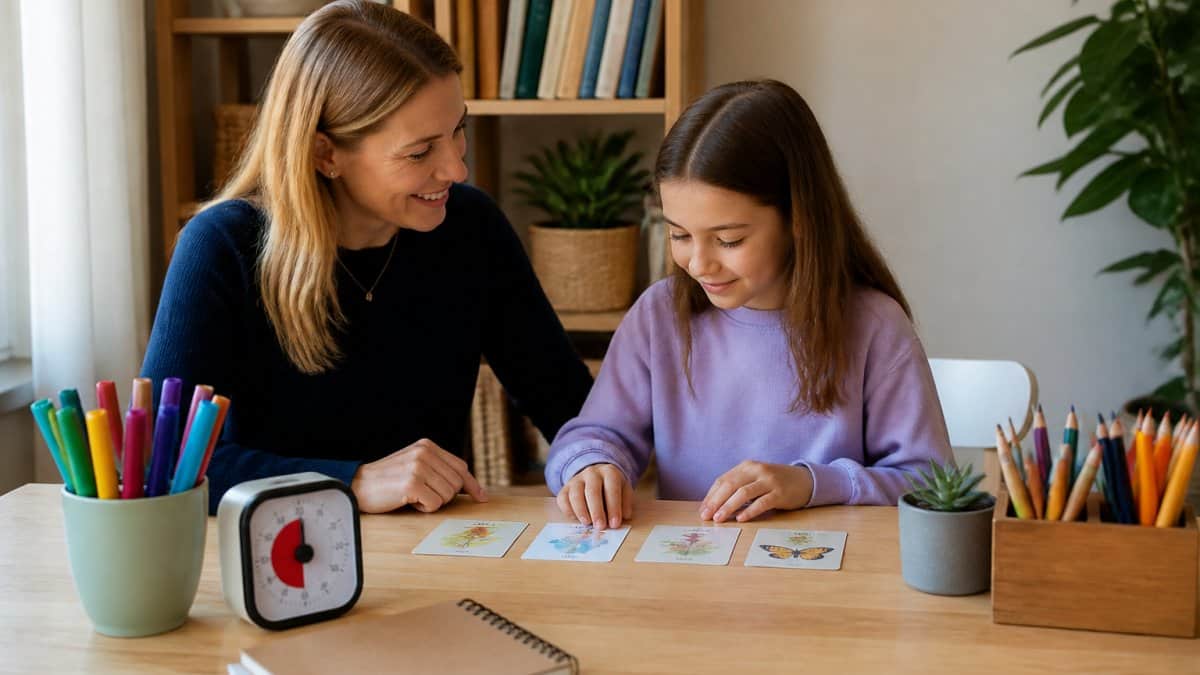
Keep the space simple. Fewer visuals on the walls, clear surfaces, and a consistent spot for work. Predictability reduces anxiety, which is often the hidden trigger behind avoidance.
Flexibility sits alongside calm. Some children focus best in the morning; others come alive in the afternoon. Let the schedule bend to your child’s natural rhythm rather than fighting it.
A few practical tweaks:
- Keep one dedicated, uncluttered work area
- Use soft, natural light where possible
- Allow movement breaks without making them a reward
- Offer a small choice of activities, not unlimited options
The Learning Nest designs its weekly content around exactly this balance: structured enough to guide, flexible enough to fit your child’s pace.
When to Seek Further Support and Resources
Seek further support when progress stalls, anxiety rises, or your child’s wellbeing suffers. There is no shame in asking for help, and early support tends to work better than waiting.
Consider reaching out to:
- Your GP for a referral to a paediatric or ADHD specialist
- An educational psychologist for a full 2e assessment
- Local home education groups for practical, lived advice
- NHS guidance on ADHD support and diagnosis for official information on pathways and waiting times
For learning approaches, UK government guidance on home education sets out your rights and responsibilities as a home educating family.
Conclusion: Helping Your Gifted Child with ADHD Thrive
Supporting gifted children with ADHD is demanding, but it is far from hopeless. The key is to hold both profiles in view at once, then build a learning life that challenges the mind and protects the wellbeing.
That is exactly what we do at The Learning Nest. Our flexible, self-paced learning has no live lessons. Weekly thematic blocks blend academic subjects with life skills and wellbeing. Differentiated levels of challenge suit learners who need both depth and support. And our teachers are UK-qualified with current enhanced DBS checks, drawing on decades of teaching experience.
Try everything free for 7 days and see how a calmer, more personal approach fits your child.
Frequently Asked Questions
What does it mean to be twice-exceptional (2e)?
A twice-exceptional child is both gifted and has a learning difference or neurodevelopmental condition such as ADHD. This means they may show advanced reasoning, creativity, or problem-solving alongside challenges with focus, organisation, or impulse control. The two profiles can mask each other, so a child might appear average or be labelled lazy when they are actually managing a genuine gap between ability and output. Understanding the 2e profile helps parents stop comparing their child to a single benchmark and instead look at where support is needed and where challenge should be raised.
How can you tell if a child is gifted or has ADHD?
The two can look similar from the outside. A gifted child who is bored may fidget, daydream, or rush work, which mirrors ADHD symptoms. A child with ADHD may struggle to finish tasks despite understanding them deeply. The key difference is consistency: giftedness tends to show uneven strengths with intense focus on preferred topics, while ADHD affects executive function across all areas. A full assessment by an educational psychologist is the only reliable way to separate them, but tracking when your child focuses easily and when they cannot gives useful clues.
What are the common challenges for gifted children with ADHD?
Gifted children with ADHD often face a widening gap between what they can understand and what they can produce. They may grasp complex ideas quickly but struggle to start or finish written work. Socially, they might feel out of step with peers who do not share their interests. Many experience anxiety or low self-esteem because their output does not match their ability. In a mainstream classroom, they can be seen as disruptive or underachieving. Recognising these patterns early lets you adjust expectations and build supports around executive function rather than intelligence.
How do you support a child who is both gifted and neurodivergent?
Start by separating ability from output. Offer challenging content at the right level while providing scaffolds for organisation, time management, and task initiation. Use a strengths-based approach: if your child loves a topic, let them go deep and use that interest to practise weaker skills. Keep routines predictable but flexible, and build in movement or breaks before frustration sets in. A self-paced learning environment with differentiated challenge, like the thematic blocks offered by The Learning Nest, can give gifted children with ADHD the intellectual stretch they need without the pressure that triggers avoidance.